
May 08, 2026
By 2026, digital marketing has shifted from channel management to adaptive systems: AI informs decisions, search rewards direct answers, video dominates discovery, and first-party data separates leaders from the rest.
If you are trying to stay ahead, you cannot rely on recycled playbooks. You need to understand where things are going and how to adapt your strategy before everyone else catches up. Let’s take a practical look at the digital marketing trends for 2026. Keep reading to find smart insights into what is changing, why it matters, and how you can act on it.
Current Digital Marketing Trends 2026
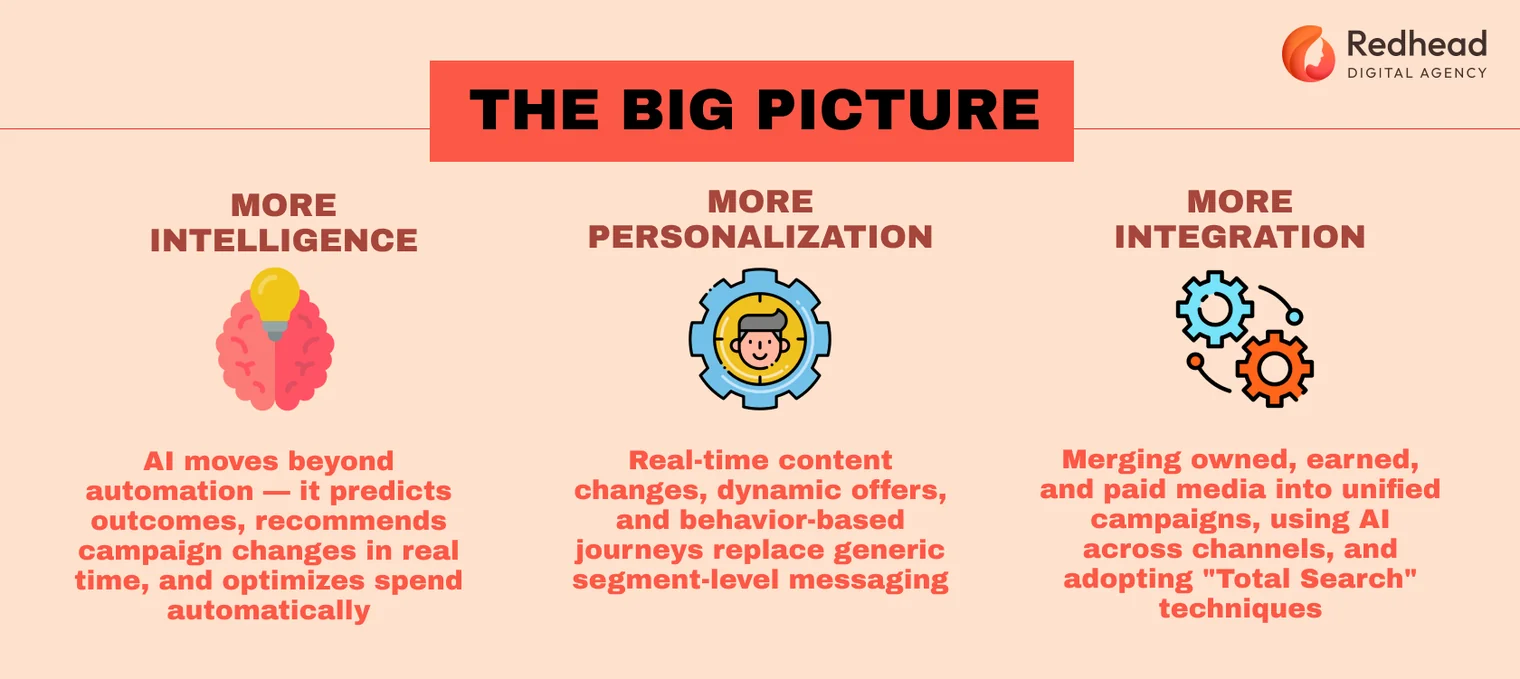
Before we dive into specific trends, it is important to understand the bigger picture. Marketing is moving toward three core principles:
- More intelligence – it is all about AI-driven decisions
- More personalization – this is about providing hyper-relevant experiences
- More integration – this one refers to connected ecosystems instead of siloed channels
The shift is not about doing more. It is about doing things smarter. The following digital marketing industry trends 2026 are expected to shape this transformation. Find last year’s trends here.
AI Becomes the Core of Marketing Decisions
Artificial intelligence is no longer just a tool for automation. In 2026, it becomes the decision-maker behind many marketing actions. Instead of simply generating content or scheduling campaigns, artificial intelligence now analyzes behavior patterns and predicts outcomes. Based on that data, it then recommends the next steps in real time. This means marketers are moving from execution roles into strategy and oversight. The depth of AI involvement is changing as well. It now touches audience segmentation, campaign optimization, and even creative direction.
Generative models are processing massive datasets and identifying patterns that humans would miss. They can predict which audience segments are most likely to convert, what messaging resonates, and when users are most active. You will be surprised to know that:
- Around 94% of marketers plan to use AI in content workflows by 2026
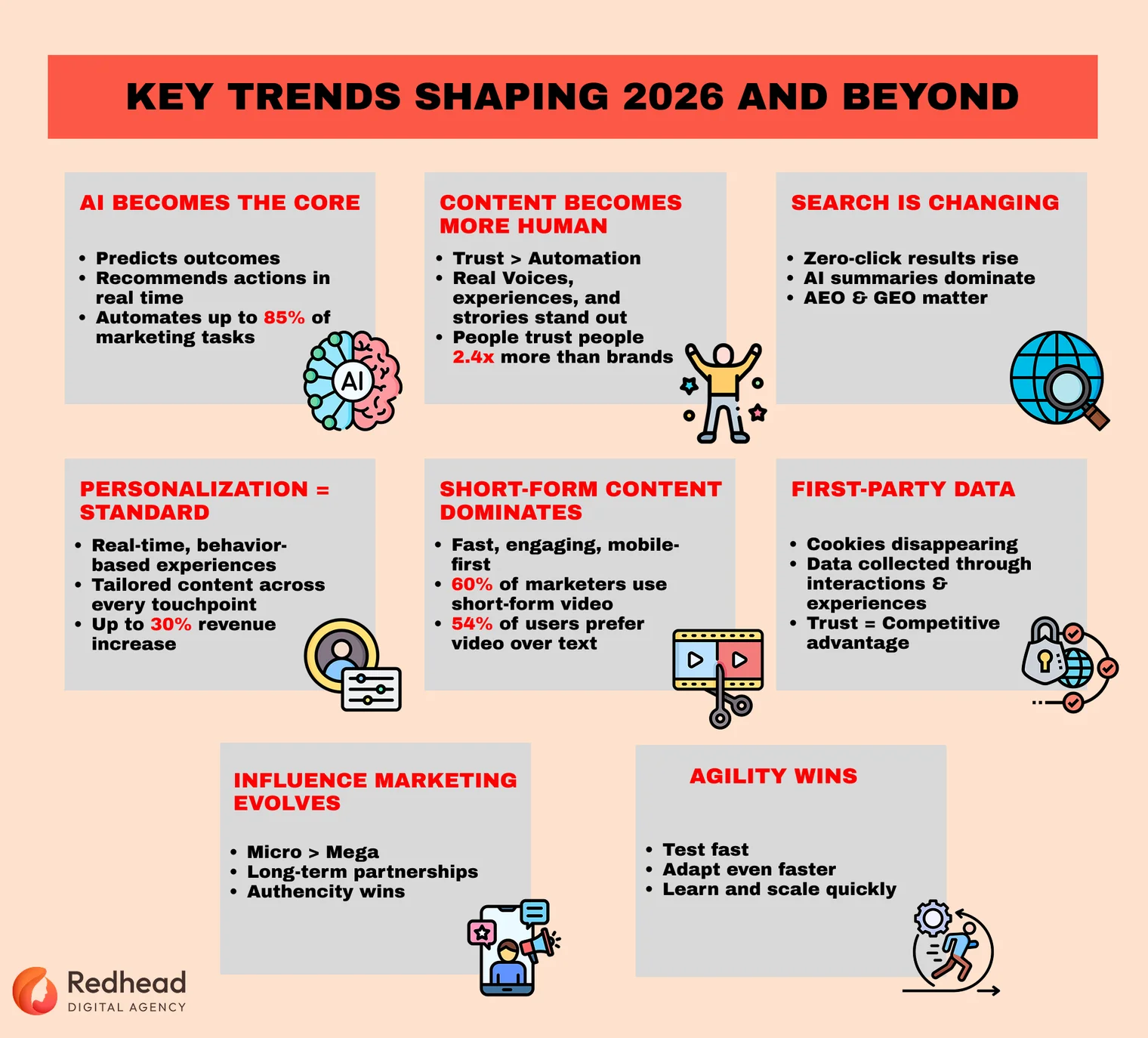
- Up to 85% of marketing tasks can be automated with AI
- AI-driven campaigns can perform 20-30% better than manual ones
We are moving into a phase where artificial intelligence predicts customer intent, recommends campaign changes in real time, and optimizes spend automatically. We can fairly call it decision intelligence.
In case you are still using manual campaign adjustments, then you are already lagging behind. Artificial intelligence enables companies to operate more quickly and make superior choices using reduced speculative work. Thus, begin to combine AI with your processes besides content-making. Apply to predictive analytics, audience insights, and campaign testing. This is not aimed at ousting the marketers but enhancing their decision-making authority.
Best practices
- Move beyond content AI. Use modern solutions for forecasting and predictive analytics.
- Build AI-assisted reports and dashboards.
- Combine AI outputs with human judgment. This is especially effective for brand voice and messaging.
- Test recommendations by artificial intelligence in controlled experiments before scaling
Search Is No Longer Just About Rankings
Search behavior is changing greatly. Users are no longer clicking through multiple links. Instead, they expect direct answers. With the rise of AI-generated summaries, zero-click results are becoming the norm. This changes how brands approach visibility.
Search engines now generate answers directly on the results page. Content is being summarized, quoted, or reinterpreted by machine learning systems. Here are a few statistics to note:
- Search engines still drive 93% of website traffic. However, user behavior is changing.
- Over 92% of marketers are already optimizing for AI-powered search environments.
Users now get answers directly from search pages, use voice assistants and AI tools, and trust summarized results instead of browsing links. In other words, traffic is no longer the only metric that matters. Visibility inside AI-generated answers becomes just as important.
This shift is where AEO and GEO come into play. The former focuses on structuring content so it can be easily picked up as a direct answer. This means using clear H2 and H3 headings, adding FAQ sections, writing short and concise paragraphs, and providing straightforward answers that search engines can extract quickly. GEO goes a step further. It is about increasing your chances of being mentioned in AI-generated responses across different platforms.
To improve your chances of being referenced by AI tools, focus on:
- Publishing well-structured, easy-to-scan content
- Covering topics clearly and completely, without fluff
- Building authority through consistent brand mentions across platforms
- Creating content that answers real user questions directly
You do not need to overcomplicate it. The goal is to make your content easy to understand, extract, and trust.
Best practices
Focus on clarity, structure, and authority. Content needs to be easy to extract, understand, and trust. Think in terms of answer-ready content rather than just SEO pages. Here are the tips and tricks to follow:
- Structure content with clear headings, concise answers, and bullet points.
- Focus on semantic SEO
- Optimize for voice search and conversational queries
- Add credibility signals. These can be expert quotes, data, and real examples
These may be quite tricky things to do, especially if you lack technical expertise. The best solution is to assign this task to a professional digital agency.
Content Becomes More Human
It is a widespread stereotype that AI-created content will take over all things. As a matter of fact, the reverse is taking place. The spread of AI content is greater. This is the reason why human-based content is more useful. Readers are becoming more attentive to generic, automated material. They are drifting towards genuine voices, original views, and actual experiences.
Most marketers are currently using AI. But that would make the content saturated. The audience gains more and more interest in real stories, opinions, and personal experiences. Customers put their faith in individuals 2.4 times more than brands. This implies that generic content is unseen content. Therefore, in case your content seems to be a template or repetitive, it will be disregarded. It now takes character and innovativeness to shine through.
Best practices
Invest in storytelling, opinions, and expertise. Use AI as a helper. It should never replace your brand voice.
- Add personal POVs and opinions. Include case studies, real examples, and behind-the-scenes insights
- Use AI for research, outlines, and drafts. But always humanize the final output
- Build author authority
Hyper-Personalization Becomes Standard
Personalization is no longer a choice. It is expected. In 2026, however, personalization will extend much further than just using the name of a person in an email. Brands are developing dynamic experiences, which vary depending on the behavior, preferences, and context of the user. Ads, emails, and websites are all real-time adapters. You should also do so because
- Personalization can increase revenue by up to 30%
- In some cases, advanced personalization can boost performance even higher (up to approx. 40% in studies)
That is why brands are now delivering real-time content changes, dynamic offers, and behavior-based journeys. Generic experiences feel irrelevant. Users expect content that reflects their needs instantly.
Best practices
Build systems that allow for flexible content delivery. Think about how your website or campaign can adapt based on who is interacting with it. Segment beyond demographics. Employ yourself with data about your audience’s behavior and intent.
Use their browsing history, engagement signals, and lifecycle stage. Implement dynamic website content and personalized email flows. Start small with 2–3 segments and then scale.
Short-Form Video Continues to Dominate
Short-form video is still one of the most powerful formats. However, it is changing all the time. It is no longer just about entertainment. It is becoming a key driver of discovery, education, and conversion. Platforms are prioritizing short, engaging videos that deliver value quickly. Brands are using video not just for awareness. They work for product education and storytelling.
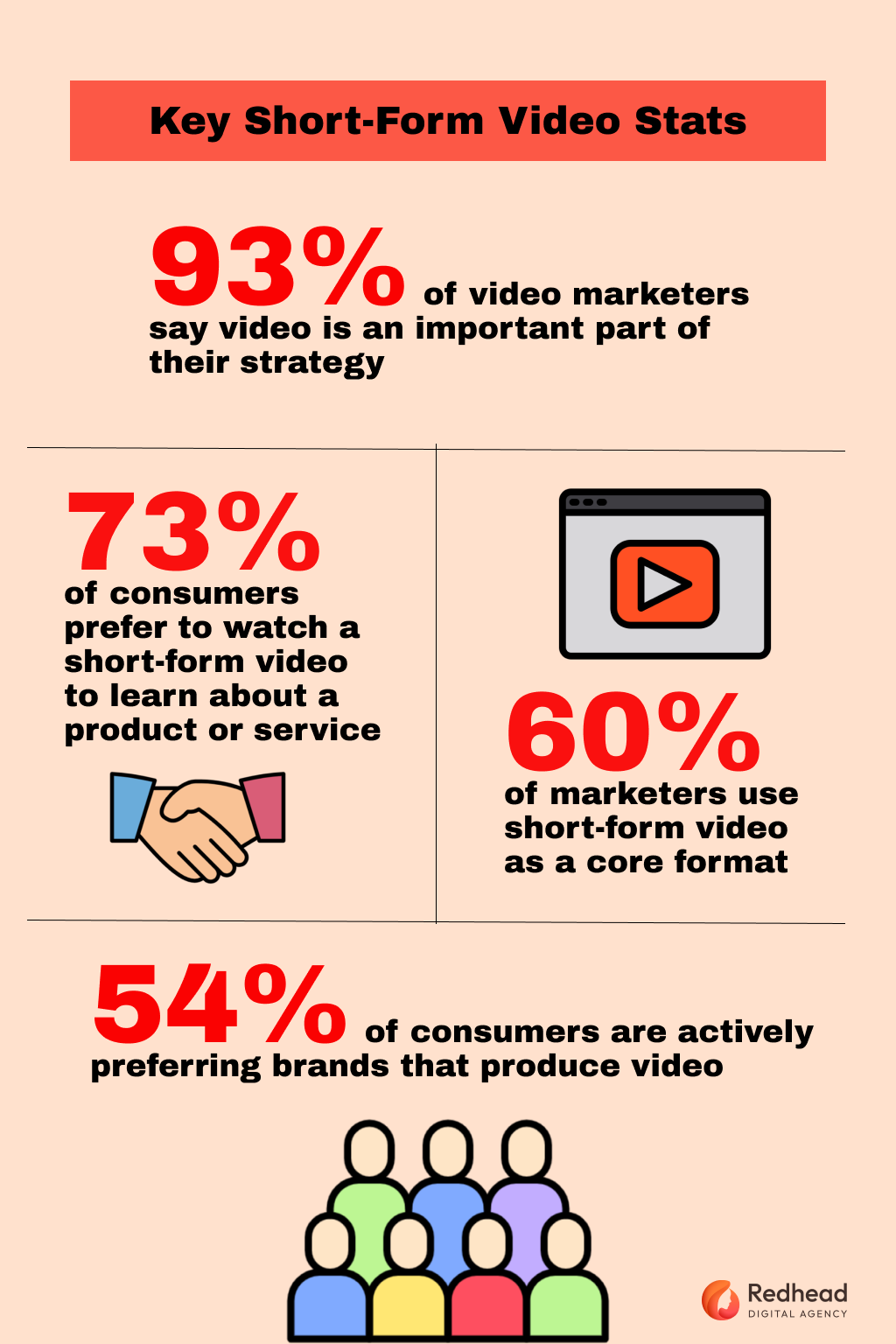
- 60% of marketers use short-form video as a core format
- 54% of consumers prefer video from brands
Attention spans are shrinking. If you cannot communicate your message quickly, you lose the audience. Video is now used across awareness, education, product demos, and conversions. It is faster to consume, easier to remember, and more engaging than text.
Best practices
Focus on clarity and value. Every second of your video should serve a purpose.
- Hook attention in the first 2–3 seconds
- Focus on one idea per video and have a clear value
- Repurpose content across platforms
- Combine educational content, storytelling, and product demos
First-Party Data Becomes Critical
With privacy regulations tightening and third-party cookies disappearing, businesses need to rethink how they collect and use data. That is why more companies are shifting to first-party data strategies. Instead of relying on external sources, they collect data directly through interactions, subscriptions, and user experiences.
Third-party cookies are becoming a thing of the past. As a result, brands must build their own data ecosystems. Strong first-party data strategies lead to more stable targeting and better long-term performance of their advertising. Without trusted data, personalization becomes harder and less effective.
Best practices
Build trust with your audience. Offer value in exchange for data, whether it is through content, tools, or exclusive access.
- Build value exchange via newsletters, gated content, and tools
- Invest in CRM systems and customer data platforms
- Be transparent about data usage and privacy policies
- Focus on data quality and updates
Communities Become Marketing Channels
Brands are no longer just broadcasting messages. They are building communities. Online communities, whether on social platforms or owned channels, are becoming spaces for engagement, feedback, and loyalty. People are shifting from passive consumption to active participation.
Communities now exist on Discord, Slack, LinkedIn groups, private platforms, etc. They drive trust, engagement, and retention. What is more important, they contribute to the organic growth. People trust people more than brands. Communities create a sense of belonging and authenticity. That is how this approach works.
Best practices
Invest in creating spaces where your audience can interact with you and each other. Create spaces for discussion.
- Encourage user-generated content and peer interaction
- Assign community managers
- Use communities for feedback, product validation, and early launches
Influencer Marketing Gets More Strategic
Influencer marketing is growing. It is no longer about the number of followers. Brands are pursuing long-term collaborations with creators who support their values and audience. They are shifting towards long-term partnerships, niche creators, and performance-based agreements.
Viewers are very keen on genuineness and conformity. Forced collaborations can be easily noticeable to the audience. And that will directly affect their confidence and loyalty to a brand.
Best practices
Choose influencers based on relevance and engagement. Focus on micro and niche influencers. Build ongoing partnerships and co-create content. Track engagement quality and conversions. Give creators creative freedom. This is key.
Marketing and Product Experience Merge
The marketing/product borderline is being erased. Experience of the user is included in the marketing strategy. One of the major growth drivers and retention is the product. It is emerging as a marketing engine and a growth channel. Thus, consider onboarding processes, in-product communication, and retention based on UX. Even an excellent campaign cannot make up for a bad experience of the product.
Best practices
Work closely with product teams. Ensure that marketing promises align with actual user experience. Align marketing and product teams. Use onboarding emails and in-app guidance. Optimize user journeys and conflicting points. Treat product experience as part of your marketing strategy.
Agility Becomes a Competitive Advantage
The pace of change is increasing. Strategies that worked last quarter may not work today. B2B companies are adopting more flexible approaches to planning and execution.
- Future trends shift faster than ever
- Platforms change constantly
- Consumer behavior changes quickly
Companies that test, adapt, and learn faster have more chances to win in this game. In other words, being able to adapt quickly is more valuable than having a perfect long-term plan.
Best practices
Target practice, research, and development. Build flexible processes. Stop developing policies once a year, work on them continuously. Run A/B tests and lightning experiments. Make decisions using real-time data. You must never sit back and follow all-the-same plans.
Digital Marketing Trends 2026 Predictions
Marketing is shifted to a more integrated, smart, and humanistic direction. Technology will only be improved. Nevertheless, the basics will never change. To begin with, you should know your audience and provide value. The difference will be in the way you get that. Here are the predictions:
- Artificial intelligence will handle more operational tasks
- Data will become more valuable and more protected
- Content will need to be both efficient and authentic
The businesses that succeed will be the ones that balance technology with human insight.
There is a lot of noise around the top digital marketing trends, tools, and tactics. However, once you take a step aside, the way becomes quite clear. The art of marketing is not getting more complex. It is becoming more precise. It is not the difficulty of learning all of the new platforms and features. It is the perception of all connections.
The best digital marketing trends cannot be described as isolated changes. They belong to a greater change in favor of smarter, more adaptive systems. Simultaneously, the trends of the digital marketing industry 2026 indicate that you will succeed to the extent to which you will be able to integrate data, creativity, and strategy.
What Stays the Same in Digital Marketing
There is so much emphasis on what is changing that we tend to forget what is not. And that is often where the real stability comes from. Nevertheless, all new tools, platforms, and technologies did not change the essence of digital marketing. Trust, relevance, and clarity are the areas people continue to base their decisions on. They continue to pick up messages that are useful, comprehensible, and congruent to their needs.
What has changed is the environment around those fundamentals and marketing ideas. There are more channels, content, and competition for attention. However, the underlying drivers of behavior are the same.
This creates an interesting dynamic. On one hand, marketers feel pressure to constantly adapt to new trends. On the other hand, the principles that drive results are surprisingly consistent. Understanding your audience, communicating clearly, and delivering value are still at the center of everything.
In 2026, the challenge is not just learning new tactics. It is knowing which fundamentals to hold onto while everything else evolves. Many businesses overcomplicate their strategies. They chase every new feature or platform, while overlooking the basics that make marketing effective.
In order to perform best, brands should combine both perspectives. Adopt new technologies where it makes sense. At the same time, they should anchor their strategy in principles that do not change. This balance allows for staying flexible without losing direction.
Why Strategy Matters More Than Tools
Digital marketing is not short of tools. Each year, there are new platforms, automations, machine learning possibilities, and methods of implementing campaigns. Nevertheless, access to tools does not always produce better outcomes. In fact, the opposite is often true.
Overreliance on tools without a clear strategy by the teams turns out to be counterproductive. The campaigns can be optimized at the individual level. But they do not all lead to any integrated system. Communication gets erratic. Priorities shift too often. And in time, performance levels off.
What is becoming clear in 2026 is that tools boost whatever strategy is already in place. If the strategy is strong, tools help scale it. If the strategy is unclear, tools simply make that lack of clarity more visible.
This is especially relevant in an AI-driven environment. AI solutions can generate content, optimize campaigns, and analyze data at scale. However, it still depends on the given direction. Without a clear understanding of your audience, positioning, and goals, even the most advanced systems cannot produce meaningful outcomes.
Strategy, in this context, is not just a high-level plan. It is the connection between all parts of your marketing. It defines how your channels work together, how your messaging evolves across touchpoints, and how your efforts contribute to long-term growth.
In practice, this means stepping back more often. Stop asking, “Which tool should we use?” There is a much more important question. What are we trying to achieve, and how does this fit into the bigger picture? The companies that succeed are not necessarily the ones using the most advanced tools. They are the ones using tools in a way that supports a clear and focused strategy.
The Challenge of Standing Out in a Saturated Market
Saturation is one of the key trends of digital marketing in 2026. Content, advertisements, and brands targeting the same audience increase. Messages attempting to attract attention are more numerous. This complicates visibility. However, it also changes how differentiation works. Standing out is no longer just about being present. It is about being distinctive.
Volume could be used to gain visibility in the past. Publishing additional content, conducting more campaigns, and reaching more people turned out to be more successful. It is not a good strategy today. Volume does not bring an advantage by itself when everybody is producing more. Rather, it is focused and clear, which brings differentiation.
For brands to stand out, it is necessary to communicate a clear point of view. They do not need to appeal to everyone. They should be specific about who they are for and what they represent. This clarity makes their messaging easier to recognize and remember.
At the same time, consistency becomes critical. In a fragmented environment, users encounter brands across multiple touchpoints. If those experiences feel disconnected, the brand becomes harder to understand. But when messaging, tone, and positioning remain consistent, recognition builds over time.
Another factor is depth. Surface-level content is easy to produce. However, it is also easy to ignore. Content that offers real insight, perspective, or value creates a stronger impression. It gives users a reason to engage, not just scroll past. In this sense, standing out is less about being louder and more about being clearer.
In 2026, the brands that succeed are not necessarily the ones that produce the most content. They should create meaning within it. They should understand that attention is limited and focus on making each interaction count.
Smart Insights for 2026: Key Takeaways
As we look across all trends, a few clear patterns are crystal-clear. Marketing is becoming more intelligent, with AI driving decisions, predicting outcomes, and automating up to 80-85% of routine tasks. At the same time, personalization is no longer optional. It directly impacts performance, with revenue increases of up to 30% when done well.
Another major shift is toward connected ecosystems. This is where data, channels, and messaging work together instead of operating in silos. Privacy-first strategies and first-party data are no less critical. They make trust a real competitive advantage. Finally, speed and adaptability define success. Brands that test, learn, and iterate quickly consistently outperform those relying on rigid long-term plans.
Let’s Wrap It Up
If there is one thing to take away, it is that marketing in 2026 is about balance. You need to use technology without losing the human touch. You need to move fast without losing focus. And you need to experiment without losing direction. The tools will keep changing. The platforms will evolve. However, the core idea stays the same. You are to connect with people in a more relevant, useful, and real way. If you can do that, you are already ahead.
Frequently Asked Questions
Q: What are the most important digital marketing trends in 2026?
A: The three biggest shifts are AI-driven decision-making, hyper-personalization at scale, and the move to first-party data strategies. Together they’re changing how brands attract, engage, and retain customers across every channel.
Q: Is AI replacing digital marketers in 2026?
A: No but it is changing the role significantly. AI handles execution: content drafts, campaign optimization, data analysis. Marketers shift toward strategy, creative direction, and brand judgment. The demand for human insight is growing, not shrinking.
Q: How do I know which digital marketing trends actually apply to my business?
A: Start with your current weak points. If your content output is low – look at AI tools. If your targeting is broad – prioritize first-party data. If your audience isn’t converting – work on personalization. Not every trend is equally urgent for every business.
Q: What’s the single biggest mistake brands make when following marketing trends?
A: Chasing tools without a clear strategy. AI, short-form video, influencer marketing – none of these work if the underlying positioning and audience understanding is missing. Tools amplify what’s already there. If the strategy is weak, tools just make that more visible.
Keep reading
Start here
Let’s move forward
You can reach us anytime.
What’s next?
1
Our managers will process your request and get back to you within one business day.
2
We will discuss all the details with you and determine the most suitable solution for your project.
3
You will choose a payment method, and we’ll begin implementing the strategy for your project.