

Sep 22, 2026
It’s a curious contradiction: the most technologically sophisticated companies invest heavily in publishing content on platforms they don’t control. But that’s exactly how guest posting works — and for the SaaS segment, it stopped being an experiment a long time ago. It’s a systematic strategy.
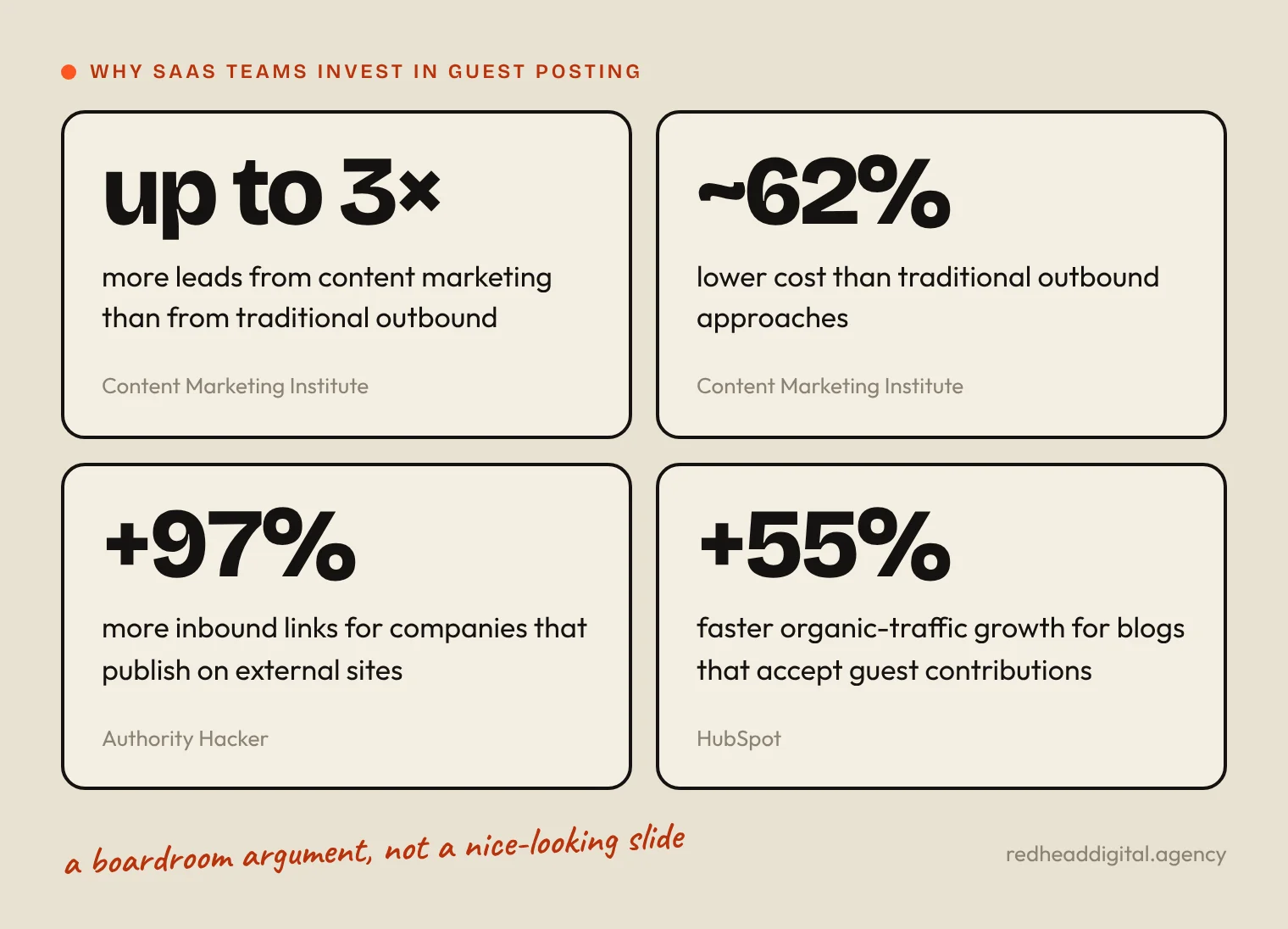
The Content Marketing Institute reports that content marketing can generate up to three times more leads than traditional outbound approaches — all while reducing costs by around 62%. For SaaS businesses, where CAC can easily run into the hundreds or thousands, this isn’t just nice-looking data. It’s a boardroom argument.
But it’s not only the numbers that make guest contributions attractive. It’s also the mechanics of trust. An article published in an independent industry outlet under your expert’s name resonates differently from content on a corporate blog. Readers see it as insight, not a promotional message. And that changes everything.
Effective Guest Posting Strategies for SaaS: What Works vs. What Doesn’t
Here’s where things get interesting. Many SaaS teams approach off-site editorial placements like a one-off campaign: write a couple of articles, get them placed, wait for traffic. Traffic doesn’t come. Conclusion — “doesn’t work.” But the problem isn’t the tool.
Effective guest posting strategies for SaaS are built on several principles that are easy to describe but surprisingly hard to follow consistently. These principles mainly revolve around two key ideas:
- Choosing the right platform
- Align your topic with audience challenges
Choosing the Right Platform Is Half the Battle
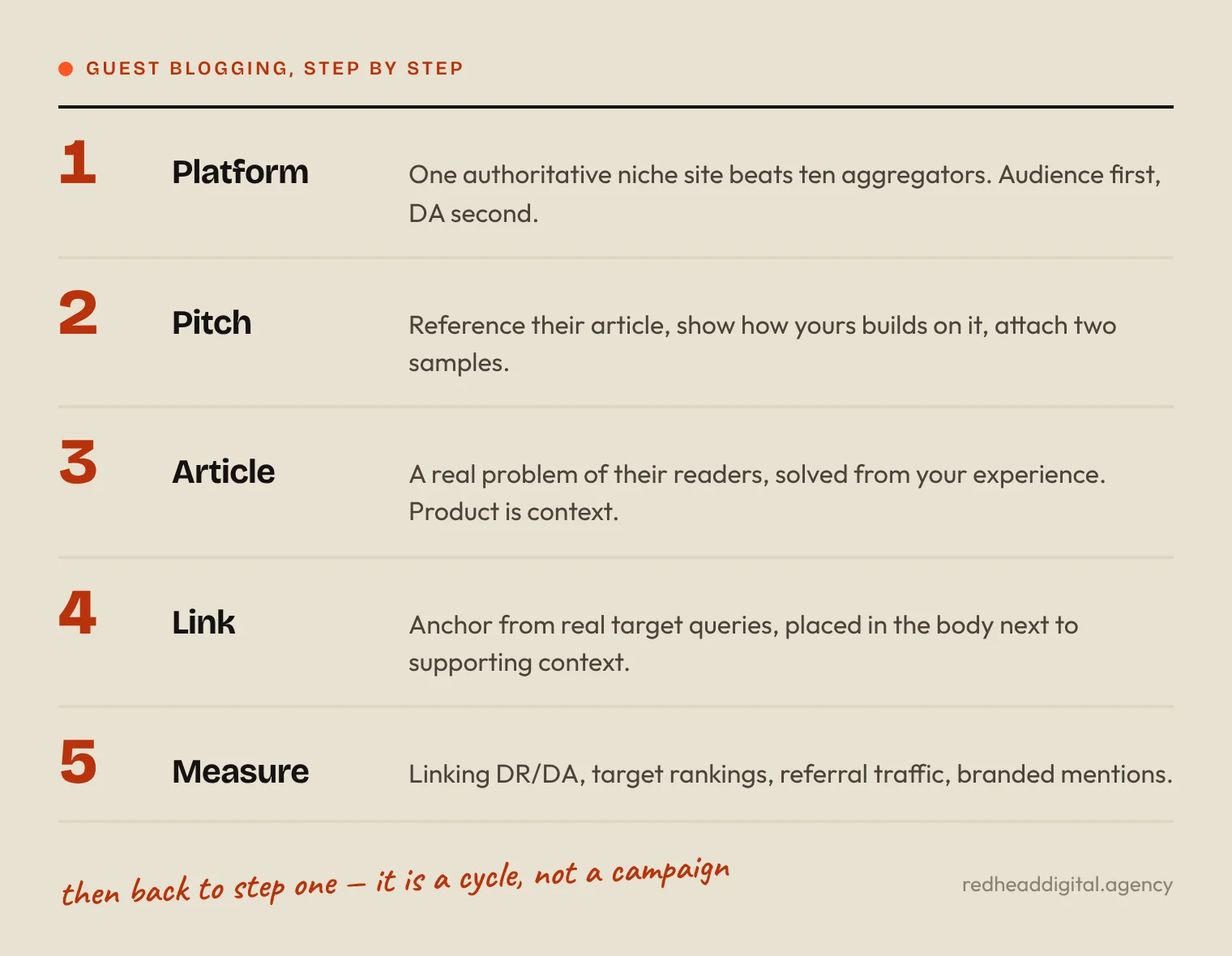
Not all publications are created equal. Getting placed on a website with a Domain Authority of 20 and zero real audience is more of an illusion of activity than actual work. The rule is simple: one publication on an authoritative niche website beats ten placements on random content aggregators every single time.
For SaaS companies, the most valuable types of platforms tend to be:
- Industry outlets your audience actually reads — marketers, DevOps, CFOs — depending on the product
- B2B educational blogs and platforms — G2 Learning Hub, Capterra, HubSpot Blog, Zapier Blog
- Technical and community platforms — Dev.to, Smashing Magazine, CSS-Tricks
Topic = Where Your Expertise Meets Your Audience’s Challenges
The most common mistake: making it all about the product. Nobody wants to read disguised advertising. Editors of serious publications sense it immediately and send those pitches straight to the bin — they’ve developed a finely tuned nose for it, frankly.
The approach that works: take a real problem that the target audience of the chosen platform faces, and offer a solution grounded in the company’s actual experience. The product is context, not the centerpiece.
SaaS Guest Blog Posting: The Mechanics Nobody Shows You in YouTube Tutorials
At the tactical level, SaaS guest blog posting isn’t simply “write and submit.” It’s a step-by-step process where every stage shapes the end result. We’re talking about:
- Getting your emails read during the outreach
- Producing quality content
- Putting emphasis on evergreen topics
Outreach: How to Keep Your Emails Out of Spam — and Actually Get Read
Every week, editors at major websites sift through dozens of pitches that all sound the same. “Hi, I’m an expert, I’d love to write something useful” — that’s not a pitch, it’s generic noise that gets overlooked. What actually gets attention is specificity: reference a similar article on their site, show how your idea builds on it, and back it up with a couple of strong writing samples.
No matter how good your pitch is, rejection can still happen. That’s fine. A conversion rate of 20–30% from cold outreach is considered strong in the industry — so don’t treat every “no” as a sign the strategy is broken.
Content Production: Quality vs. Volume
Some teams try to scale off-site editorial placements purely through volume — 20 articles a month across different websites. If that volume is backed by genuine expertise and real quality, it can work. If not, publications stop accepting submissions, and Google has gotten remarkably good at recognizing templated, pattern-driven content.
For most SaaS companies starting out, the optimal model is 4–6 high-quality publications per month on carefully selected websites, combined with regular analysis: which topics generate the most engagement, which platforms drive traffic that actually converts.
Evergreen vs. Trending Topics
Here’s where a real fork in the road appears. Trending topics generate a quick spike in traffic; evergreen content produces a stable organic flow for years. For SaaS SEO growth, evergreen wins: an article titled “How to Reduce Churn in SaaS: 7 Proven Frameworks” will pull in traffic for three years. An article called “How GPT-4 Is Transforming SaaS in 2023” — not so much anymore.
If you think about it, that’s the core tension in any content strategy. Short-term visibility versus long-term compounding. SaaS link building through guest articles, done right, leans heavily toward the latter.
Is Guest Posting Effective for SaaS Companies? An Honest Answer Without the Marketing Spin
Yes, guest posting works for SaaS companies — but only when three specific factors align. Get them right, and it drives qualified traffic, builds authority in a competitive space, and supports long-term pipeline. Get them wrong, and it’s just content for content’s sake. Guest posting effectiveness for SaaS companies depends directly on:
- Choosing the right platforms
- Making the content genuinely relevant to the audience
- Approaching the whole thing systematically
Meet these conditions, and the results speak for themselves.
Here’s some concrete data. According to Authority Hacker, about 65% of marketers identify link building — of which guest contributions are a core component — as one of the top three drivers of organic traffic growth. Companies that actively pursue external publications earn, on average, 97% more inbound links compared to those that don’t. That’s not a casual correlation.
HubSpot research found that blogs actively practicing guest contribution grow roughly 55% faster in organic traffic metrics than those that stay closed. For a SaaS company where organic search is a primary acquisition channel, that number deserves serious attention.
And there’s a less obvious effect worth mentioning. How guest blog posting supports SaaS digital marketing goes well beyond pure SEO. It’s about building reputation at scale. When a startup’s CTO regularly publishes in TechCrunch, VentureBeat, or Hacker Noon, that does more for brand recognition among a technical audience than paid advertising with an equivalent budget. Possibly quite a lot more, actually.
There’s also something rarely discussed: guest articles build credibility with investors. A portfolio of publications in respected industry outlets is a signal that a company has genuine expertise and a real media presence. It’s a small, but tangible plus during due diligence conversations.
Benefits of Guest Posting for SaaS Companies: What the Business Actually Gets
Let’s put it plainly — when you try to gather all the advantages in one place, the picture becomes compelling. The benefits of guest posting for SaaS companies can be organized across several dimensions, and each one touches real business metrics.
SEO and link equity. Every quality publication on an authoritative website is a potential backlink. For SaaS companies where competition in organic search results is frequently intense, even a handful of strong links can meaningfully move rankings on target queries.
Topical relevance. The SEO value goes further than raw link counts. Placements on topically relevant platforms signal subject-matter authority — not just general domain strength. That topical relevance drives authority transfer on the exact queries that matter, and actively supports non-branded rankings, pulling in users who are searching for a solution but don’t know your product yet. There’s also a compounding effect worth noting: each placement builds on the previous ones, and over time, the cumulative weight of a consistent guest blogging program becomes a durable competitive advantage in organic search.
Branding and authority. Regular presence in niche publications gradually transforms a company — or its key people — into recognized voices in the industry. That’s a long-term asset that simply can’t be purchased directly.
Referral traffic. Not every platform will deliver a major SEO boost, but almost every one can bring real readers. Especially when the material is genuinely useful — people share it, link back to it, discover it through internal search on the publication itself.
Networking with editors and fellow experts. This one rarely gets mentioned, but it’s real. Contributed content builds relationships with editors at leading publications, which opens doors to repeat placements, expert commentary opportunities, and collaborative content down the line.
Well, exactly — none of these are abstract theoretical benefits. Execute the strategy right, and these results become real and measurable.
How to Turn SaaS Guest Posting from a One-Off Article into a Scalable System
One SaaS guest post is an experiment. Ten is a pattern. A hundred is a system that works for the company around the clock.
Scaling SaaS guest posting starts with infrastructure. That means a database of target publications, scored by domain authority, audience relevance, and editorial guideline requirements. A content calendar where topics are mapped to target keywords rather than invented at the last minute. An outreach workflow with templates that get genuinely adapted for each specific website.
Guideline: Your Best Friend in the Room
Every publication that accepts external contributions has its own guideline — a document outlining requirements for length, format, linking, and tone. Ignoring it is practically a guarantee that the pitch will fail before it’s even read. Studying it carefully, on the other hand, signals professionalism before a single word of the article is written.
The most practical move: build a spreadsheet of all target platforms and document the key points from each guideline. That saves time on every subsequent outreach cycle and reduces rejection rates in a surprisingly significant way.
Anchor Strategy and Link Placement
Even a strong backlink underperforms if the surrounding context is sloppy. A deliberate anchor strategy means choosing anchor text that reflects real target queries — not defaulting to branded terms every time, and not over-optimizing with exact-match phrases that look unnatural to editors. The goal is variation that reads organically while still signaling relevance to search engines.
Link placement matters just as much: a link embedded naturally within the body of an article, close to relevant supporting context, carries more weight than one dropped into a bio or tucked into a conclusion. Both decisions should be documented in your outreach workflow, so they’re applied consistently across every placement, not improvised each time.
What to Measure — and Why Most Teams Get This Wrong
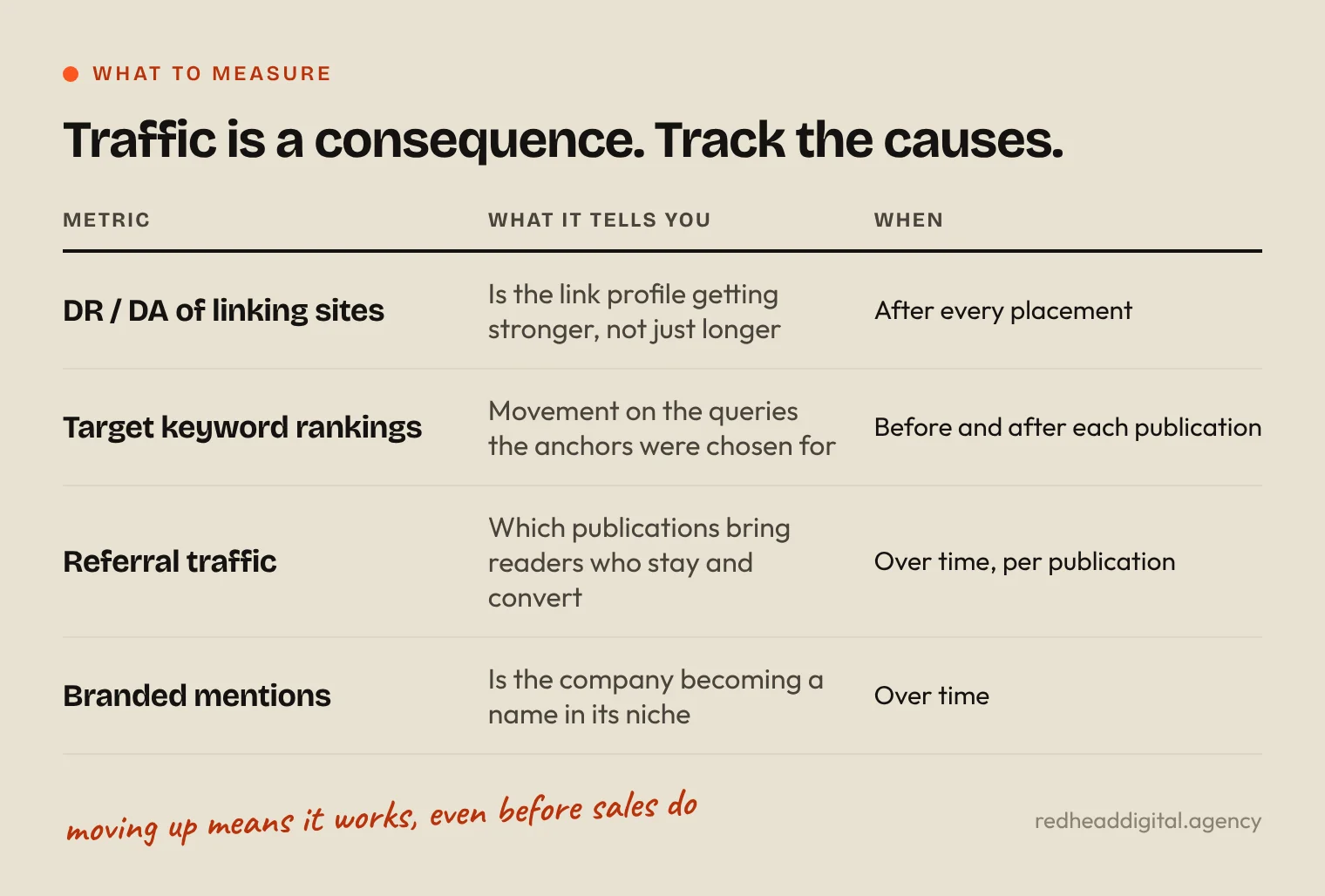
Many companies make the mistake of judging off-site editorial placements solely by traffic numbers. But traffic is a consequence, not a cause. The metrics worth tracking include:
- Changes in the DR/DA of linking websites and the dynamics of the company’s own link profile
- Rankings on target keyword queries before and after each publication
- Referral traffic from specific publications over time
- Volume of branded mentions in the broader media landscape
When these indicators are moving up, it’s a sign the strategy is working — even if sales haven’t picked up yet. SEO is a long journey, not a quick race. And external publications are one of the smartest ways to gain a consistent edge in the SEO race.
Building the Right Team for Guest Posting at Scale
Here’s something practical teams often overlook when they move from “trying guest articles” to “running guest posting as a channel.” Scale exposes the problem: one person handling everything becomes the bottleneck. The work splits naturally into distinct roles:
- Someone who researches platforms and manages relationships with editors
- Someone who writes or coordinates writers
- Someone who tracks performance and adjusts the strategy
Some SaaS companies do it all in-house. Others outsource the writing while keeping strategy and outreach internal. Both models can work — the key is that the process doesn’t depend on any single person’s memory or goodwill. It runs because the system runs.
The Long Game Nobody Talks About
SaaS link building through guest articles isn’t a trending tactic or a temporary fix. It’s a long-term investment in authority, visibility, and trust — and the compounding nature of that investment is what makes it genuinely powerful over time.
Companies that start building this system today will have a measurable competitive advantage in twelve months. Not because of luck. Because a complex, sustained process was built deliberately and maintained consistently.
To be fair, quick results shouldn’t be expected. The first three months are almost always an investment without a visible return. Then the compound effect kicks in: links accumulate, rankings shift, and reputation forms layer by layer. And at some point, organic becomes one of the company’s strongest acquisition channels — not by accident, but as a direct result of methodical, unglamorous guest contribution work.
Slow at first, then all at once — that’s SEO. If your SaaS team is ready to turn guest articles into a consistent SEO growth channel, we can help. Our guest posting services are built specifically for SaaS companies — from identifying the right publications to handling outreach, content, and link placement end to end. No one-off experiments. Just a system that compounds over time.
Keep reading


Start here
Let’s move forward
You can reach us anytime.
What’s next?
1
Our managers will process your request and get back to you within one business day.
2
We will discuss all the details with you and determine the most suitable solution for your project.
3
You will choose a payment method, and we’ll begin implementing the strategy for your project.