

Oct 09, 2026
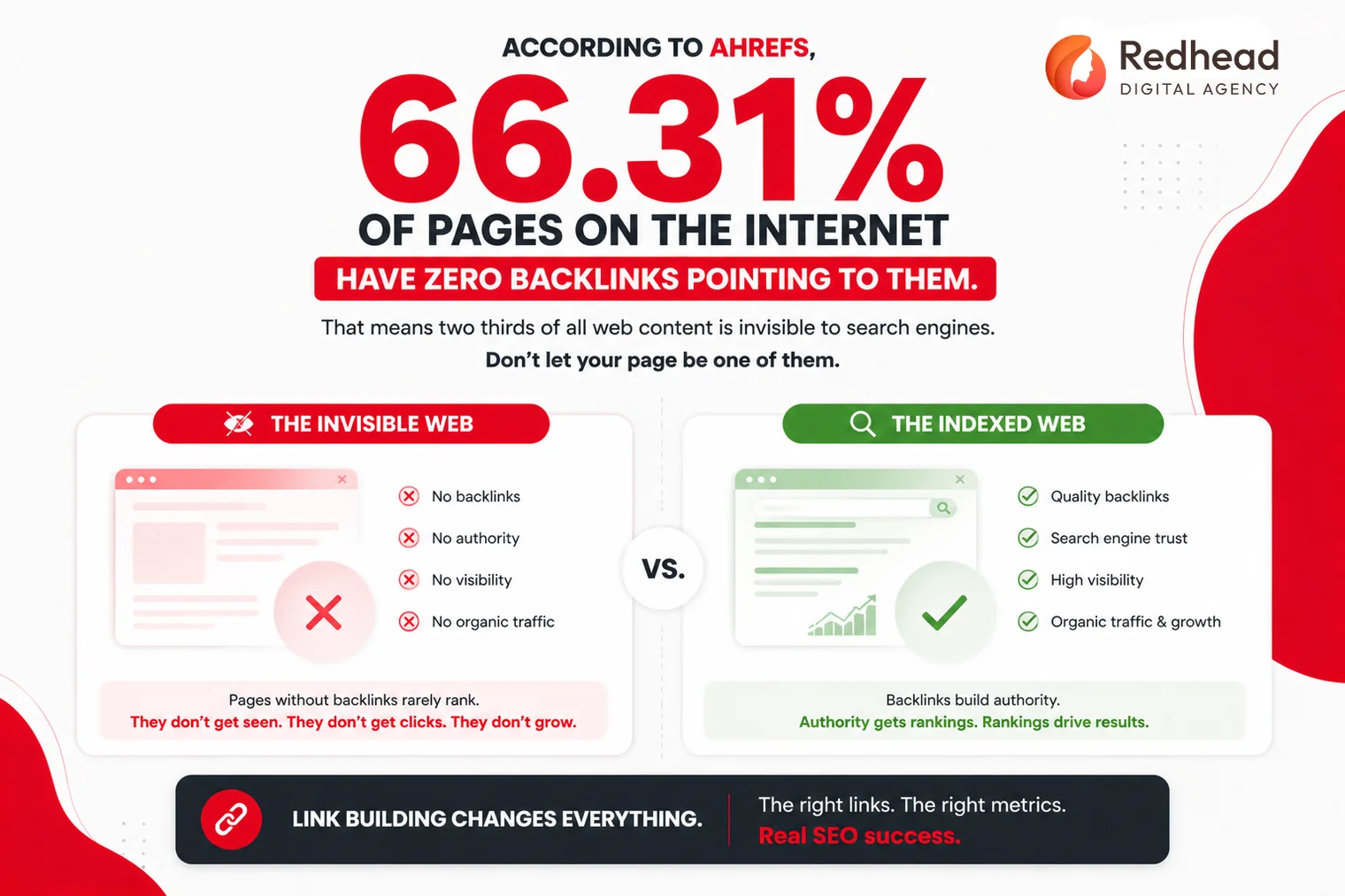
According to Ahrefs, 66.31% of pages on the internet have zero backlinks pointing to them. Two thirds of all web content is essentially invisible to search engines. That single statistic explains why link building remains one of the most powerful SEO levers available — and why measuring it properly matters more than most teams realize.
Here’s what matters most in the link building 2026 metrics:
- Referring domains
- Link relevance
- Link quality
- Keyword movement on linked pages
- Organic traffic
- Referral traffic
- Anchor text balance
The rest only matters if it supports those outcomes.
How to Measure Link Building Success: Starting With the Right Foundation
Before measuring results, define what success means for your campaign — rankings, traffic, or authority. Then set up tracking for keywords, referral traffic, and link indexing. Without this baseline, even strong links are hard to evaluate.
Why Most Teams Are Looking at the Wrong Numbers
The most common mistake in link building measurement is fixating on volume. “We acquired 60 links this month.” sounds great in a report. It means very little if 45 of those links sit on abandoned blogs with no traffic and no topical relevance.
How to measure link building success? It comes down to the measurable impact each link has on rankings, traffic, and authority — not the total number acquired.
Think of a link profile the way you’d think of an investment portfolio. Some assets grow. Some shrink. Some aren’t assets at all. When you start viewing links as assets to manage rather than numbers to collect, the entire measurement framework shifts.
According to Backlinko, the #1 spot in Google comes with a big advantage — around 3.8 times more backlinks than the other top results. The critical word is “average,” while the unspoken condition is quality. Raw link counts don’t tell the story. The composition of those links does.
The Role of Link Relevance in Early Assessment
Before diving into specific metrics, link relevance deserves a standalone mention — because it’s the factor that determines whether a link has any chance of moving the needle at all. You’re better off with a relevant mid-tier site than a top-tier one that has nothing to do with your niche.
So when you’re looking at a link, don’t start by asking, “What’s the DA?” What matters is simple: does the site fit your space, and does the link feel natural? That framing changes everything about how campaigns get evaluated from day one.
Metrics for Success of Link Building Campaign: The Core Stack
Once the strategic foundation is in place, the conversation turns to specific indicators. Not all metrics are created equal — and some that look impressive on the surface tell you almost nothing useful.
| Metric | What it shows | Why it matters | When to check |
|---|---|---|---|
| Referring Domains | The number of unique websites linking to your site, as opposed to total raw backlink count. | Diversity of linking sources is a stronger signal than volume from the same few domains. One new referring domain outweighs ten extra links from a site already linking to you. | Monthly — track steady growth. |
| Link Quality | A composite of linking domain authority, page-level traffic, editorial context, topical alignment, and link placement (body vs. footer/sidebar). | DR/DA are proxy metrics, not Google metrics. A niche DA 35 site with real readers can outperform a DA 75 directory with no human visitors. Placement in body content is worth far more than a footer link. | Per link acquired. |
| Keyword Rankings | Position changes for the specific queries targeted by the pages receiving links. | Rankings are a downstream effect — they confirm links are working on the right pages. Flat non-branded rankings while branded terms grow signals a targeting or page-alignment problem. | 10–14 weeks after link acquisition. |
| Organic Traffic | Sessions arriving from search engines — the cumulative payoff of improved rankings over time. | The most direct evidence that link building is translating into business value. A lagging indicator, but the most meaningful one for proving campaign impact. | Monthly trend review. |
| Referral Traffic | Direct clicks from linking pages to your site, visible in analytics as referral sessions. | Proves the linking page has a real audience. Referral visitors typically show lower bounce rates, longer sessions, and higher conversion rates. Zero referral clicks in 60 days is a red flag about link quality. | 60 days post-placement. |
Referring Domains: The Metric That Actually Scales
A common point of confusion — even among experienced SEOs — is the difference between total backlinks and referring domains. Referring domains = unique websites linking to you. One new referring domain is worth dramatically more than ten additional links from a domain that’s already linking to you.
Google’s own documentation confirms that diversity of linking sources is a meaningful signal. And the data backs it up — sites with a broader referring domain base tend to outperform competitors who have higher raw link counts from a concentrated set of sources. One of the easiest ways to tell if things are working? Watch your referring domains grow each month. A sharp vertical spike in a 48-hour window is a pattern worth investigating — fast.
Link Quality: Beyond Domain Authority
Domain Rating from Ahrefs and Domain Authority from Moz are useful proxy metrics — but they’re not Google metrics, and treating them as gospel leads to bad decisions. A DA 35 niche site with genuine editorial standards and 15,000 monthly readers in your exact target market can outperform a DA 75 general-interest directory that no human actually visits.
Link quality is a composite assessment. It involves the authority of the linking domain, yes — but also the traffic on the specific linking page, the editorial context of the placement, the topical alignment, and whether the link sits in body content versus a sidebar or footer. A link buried in a footer carries a fraction of the value of a contextual, editorial link in the body of a relevant article. These distinctions matter enormously and don’t show up in a single metric.
Keyword Rankings: The Downstream Effect
Keyword rankings don’t move instantly. After acquiring a strong backlink, the typical visible effect on positions takes somewhere between 10 and 14 weeks to materialize — sometimes longer for competitive queries. That lag is why campaigns get abandoned prematurely, and why short reporting cycles create misleading pictures.
The right approach is to track keyword rankings for the specific pages receiving links, not the domain broadly. If links are pointing to a product page targeting a set of commercial queries, those are the rankings to watch. If organic traffic is growing only for branded terms while non-branded positions stay flat, the links aren’t doing what they should — or they’re pointing at the wrong pages.
Organic Traffic and Referral Traffic: Two Sides of the Same Coin
Organic traffic — sessions arriving via search engines — is the long-term payoff of improved rankings. It’s a lagging indicator, but it’s the most direct proof that link building is translating into business value.
Referral traffic deserves equal attention and often gets far less. Referral traffic represents direct clicks from linking pages to your site. If a link is placed on a page with an engaged readership, those readers click through — and that traffic shows up in analytics. Beyond the volume, referral traffic quality tends to be exceptional: lower bounce rates, longer session durations, higher conversion rates than many other channels.
Here’s a useful diagnostic: if a newly acquired link generates zero referral traffic over 60 days, the linking page probably has no real audience. That’s valuable information — and it’s a signal worth factoring into future outreach targeting.
Link Building KPI: What Belongs in a Real Report
Building KPIs That Connect to Business Outcomes
KPI link building should be tied to outcomes, not just activity. “We sent 200 outreach emails” is an activity. “Keyword rankings for our target cluster improved by an average of 8 positions over the quarter” is an outcome. The distinction matters enormously when reporting to clients, stakeholders, or leadership who don’t live inside SEO tools.
A functional KPI framework for link building typically includes the following:
- Monthly referring domain growth — net new unique domains acquired, tracked over rolling 3-month periods
- Keyword ranking movement on target pages and priority query clusters
- Organic traffic growth on pages where link building was actively concentrated
- Referral traffic volume and quality from newly acquired links
- Domain Rating / Domain Authority trajectory as a long-term authority signal
Worth noting: the temptation to stack KPIs with metrics that inflate easily — like total backlink count — should be resisted. Vanity metrics feel good in reports and obscure what’s actually happening in search performance.
Reporting Cadence: How Often to Look at the Numbers
Weekly link building reports are usually counterproductive. Search algorithms don’t respond on a weekly cycle, and checking Domain Rating every seven days is roughly equivalent to weighing yourself after every meal — you’ll see noise, not signal. Monthly monitoring with quarterly trend analysis tends to give a far more accurate picture of where a campaign stands and where it’s heading.
Link Building Metrics and Tracking: Tools and Systems
Dispersed data across multiple platforms, without a consistent framework, makes reporting difficult and obscures key insights. Link building metrics and tracking work best when built around a small, integrated stack:
- Ahrefs or Semrush for backlink profile monitoring and new link alerts
- Google Search Console for position and click data
- Google Analytics 4 for organic and referral traffic analysis
The tools matter less than the discipline. Best metrics for link building SEO don’t deliver insight if they’re reviewed sporadically. Build a dashboard that aggregates the core numbers automatically, and review it on a fixed monthly schedule — not “when someone asks for a report.”
Anchor Text Distribution: The Overlooked Signal
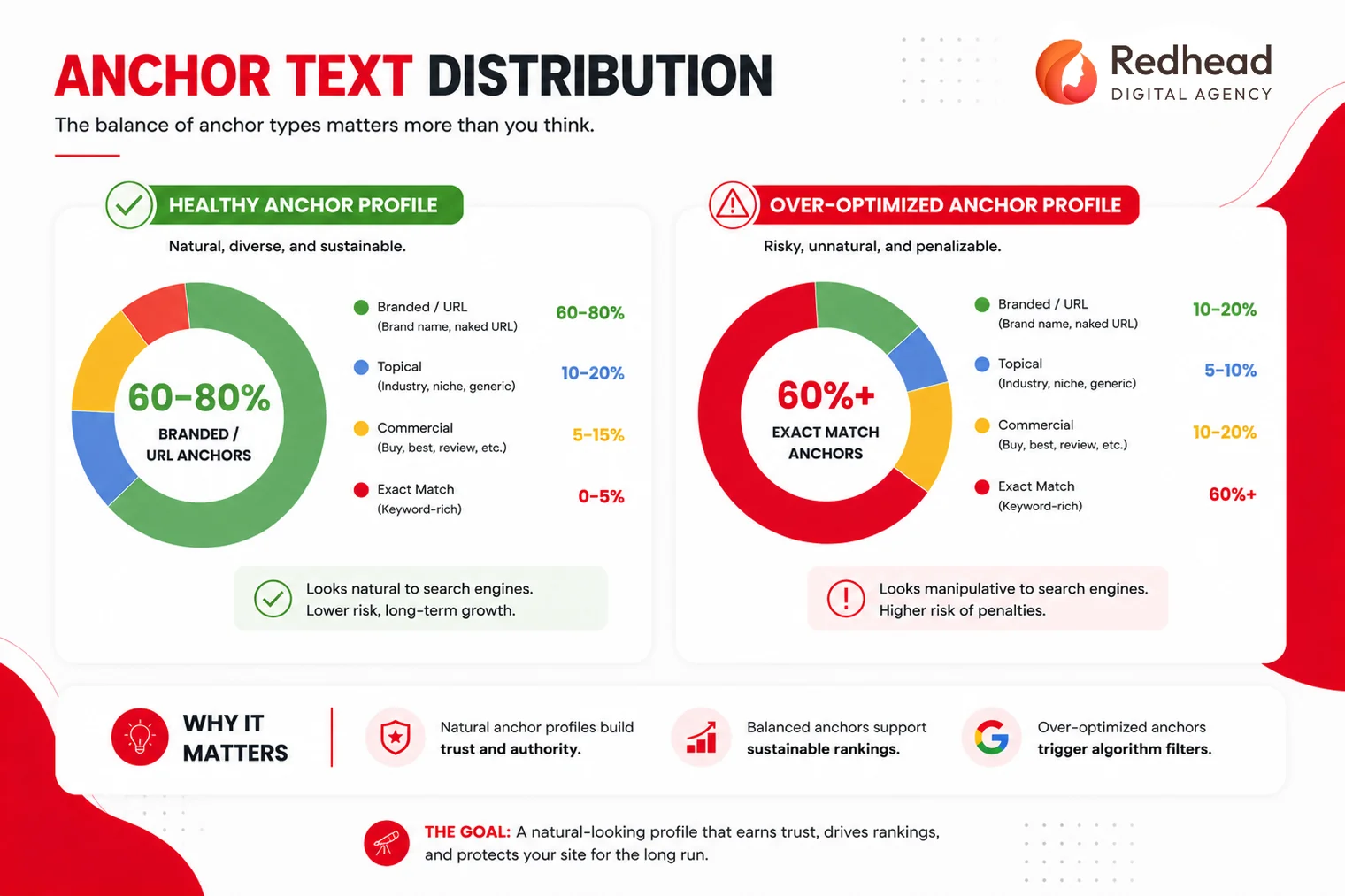
Anchor text distribution is one of those metrics that gets treated as secondary until a site gets hit with a manual penalty — and then suddenly everyone’s paying attention. Over-optimization of commercial anchors (“buy,” “best [service],” exact-match keywords) has historically been one of the cleaner triggers for Google’s link-related filters.
Research consistently shows that authoritative sites maintain anchor profiles where 60–80% of backlinks use branded or URL-based anchors, with the remainder split between topical and commercial terms. Link building success metrics should include anchor distribution analysis — not as an obsession, but as a hygiene check.
B2B Campaigns: Where Standard Metrics Fall Short
B2B is a different environment. The sales cycle is longer, the target audience is narrower, and a single link from the right industry publication can carry more weight than thirty links from general-interest sites. Accordingly, B2B link building campaign success metrics look meaningfully different from B2C benchmarks.
Where B2C prioritizes velocity — how quickly the link profile is growing — B2B rewards precision. Three placements in respected vertical publications beat thirty links from broadly-themed content farms. And for B2B specifically, the quality of referral traffic becomes a critical success metric in its own right: are the visitors arriving from those links actual decision-makers? What’s the engagement rate? Are they converting on lead forms or requesting demos? A link from a niche trade publication doesn’t just boost a ranking — it potentially delivers a qualified prospect.
How to Measure Success of Link Building Campaign: Connecting Data to Decisions
Moving From Metrics to Conclusions
Collecting data is the easy part. Turning that data into actionable conclusions is where most teams struggle. Understanding how to measure success of link building campaign requires comparison — not just “rankings went up,” but “these 12 pages that received active link building outperformed the control group of similar pages by X% in organic traffic over 90 days.”
One underused approach is internal benchmarking: comparing pages that received links against similar pages on the same site that didn’t. This isolates the link effect from broader SEO changes, technical improvements, or seasonal fluctuations. Metrics to evaluate link building success become far more convincing when there’s a control group — because then the data tells a story, not just a number.
Separating Correlation From Causation
This point matters more than most SEO content acknowledges. An increase in traffic after a link-building campaign doesn’t necessarily mean the links were the cause. It might not be the links at all — the site could’ve improved technically, upgraded content, or just caught a boost from an algorithm update.
Metrics used in link building only make sense when you look at them together with the bigger SEO picture. If organic traffic jumped 35% but rankings on target pages didn’t move, links probably aren’t the explanation. If both rankings and referral traffic moved in the same direction, on the same pages, over the expected timeframe — that’s a coherent picture worth presenting with confidence.
Putting the Measurement System Together
Link building campaign success metrics work best when organized across time horizons rather than viewed as a flat list. Short-term signals — new referring domains, early referral traffic — confirm that outreach is converting into placements. Medium-term results at the 60–90 day mark show whether those placements are influencing keyword rankings and organic traffic on target pages. Long-term indicators at six months and beyond reveal whether Domain Rating is trending upward and whether the site has become less reliant on paid traffic to maintain visibility.
Link relevance threads through all of it. Every link in the profile should be traceable back to a topically coherent source — because relevance is how link equity flows effectively, and a profile full of unrelated links offers less signal value regardless of the raw authority numbers attached to those domains.
The teams that actually get results aren’t the ones with the prettiest reports — they’re the ones tracking a few key metrics, sticking with them, and using that data to make decisions. Simple in theory, hard in practice — that’s the whole game.
Link building isn’t magic. With the right measurement framework in place, though, it becomes something more useful than magic: it becomes predictable.

Start here
Let’s move forward
You can reach us anytime.
What’s next?
1
Our managers will process your request and get back to you within one business day.
2
We will discuss all the details with you and determine the most suitable solution for your project.
3
You will choose a payment method, and we’ll begin implementing the strategy for your project.
Rather talk?
Leave your number and we’ll get in touch within one business day. Our team is in Dubai (GMT+4) and will reach you at a time that works in your time zone.